Skip to content
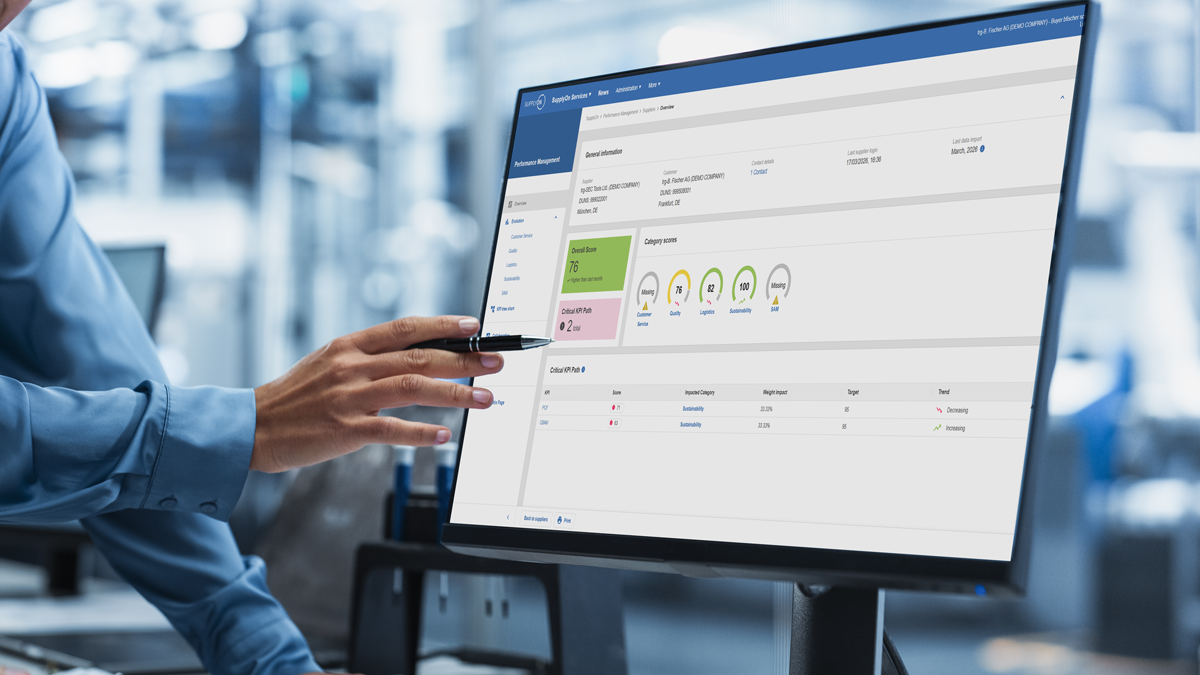
A computer screen displays a performance management dashboard with metrics, category scores, and status indicators in a web application interface.
  • Supplier Performance Management

Make supplier performance transparent and actionable

Identify performance issues earlier, understand what is driving them, and create a shared basis for improvement with your suppliers.

✓ See where supplier performance requires attention
✓ Understand the operational context behind performance results
✓ Support focused supplier improvement

Trusted by leading manufacturing companies to manage complex, global supply chains and supplier collaboration processes.


  • Bosch logo featuring a circular emblem with a stylised H on the left and the word BOSCH in bold uppercase letters on the right.
  • Safran logo featuring a stylised S design inside a circle to the left of the word SAFRAN in bold capital letters.
  • Benteler logo in grey with the slogan makes it happen beneath the company name and a triangular symbol to the right.
  • The image displays the Airbus logo in bold, uppercase black letters on a white background.
  • The Schneider Electric logo in grey, featuring the company name in bold text with a stylised S symbol between the words Schneider and Electric.
  • The image shows the Siemens logo, featuring the word SIEMENS in bold, grey capital letters on a white background.
  • Thyssenkrupp logo in grey, featuring three interlocking circles to the left of the company's name in lowercase letters.
  • The image displays the word SCHAEFFLER in uppercase, grey, bold serif letters on a white background.
  • Black and white ZF logo, featuring the letters ZF inside a circle on a plain white background.
  • AUMOVIO logo with a stylised grey A symbol on the left and the word AUMOVIO in bold black letters on a white background.
  • Schindler logo featuring a metallic circular design with a triangular shape inside, and the word Schindler in grey text below the symbol.
  • The image displays the word oerlikon in bold, grey lowercase letters on a white background.
  • Leonardo logo in grey with a stylised fan-shaped emblem to the left of the word LEONARDO in uppercase letters.
  • The word KEENFINITY is written in bold, uppercase black letters on a white background, with a stylised K featuring a diagonal line.
How it works

From supplier evaluation to focused improvement

Supplier performance management connects high-level evaluation with the operational detail needed to understand and address performance issues.

1. Evaluate performance: Assess supplier performance using defined KPIs, categories, targets, and scoring logic.

2. Identify changes: Monitor scores and trends to recognize critical or deteriorating performance.

3. Investigate the drivers: Move from an overall supplier result to the KPIs and business context behind it.

4. Align with suppliers: Give suppliers access to the performance information relevant to them and establish a common basis for discussion.

5. Support improvement: Use the performance context as a basis for focused follow-up and, where available, structured improvement actions.

The Challenge

When supplier performance lacks transparency, improvement stalls

Many supplier performance processes still rely on static scorecards, offline calculations, and disconnected follow-up. Buyers can see that performance is slipping, but not always why. Suppliers see results, but not the logic behind them. And when action is required, it often happens outside the performance system with limited traceability.

SupplyOn turns supplier performance management into a transparent, KPI-driven, and collaborative process that connects evaluation, monitoring, and action.

The overall picture and operational detail are disconnected

High-level supplier scorecards do not always provide an easy path to the detailed performance information needed to understand where issues originate.

Performance issues are difficult to pinpoint

When operational data is fragmented, identifying the specific plants, parts, locations, or other business contexts driving a deviation can require considerable effort.

Buyers and suppliers lack a shared performance reference

When results are distributed through reports, spreadsheets, and individual communication, maintaining a consistent and transparent basis for performance discussions becomes difficult.

The SupplyOn approach

Transform supplier performance management into a continuous improvement process

SupplyOn Performance Management brings supplier evaluations, operational performance, and historical performance information into one structured environment.

Buyers can monitor performance consistently across their supplier base, investigate developments in detail, and give suppliers access to the performance information relevant to them.

Manage supplier performance in one structured process

Create supplier scorecards that reflect how your organization evaluates supplier performance. Structure evaluations from an overall score through performance categories to detailed KPIs, with configurable targets, thresholds, traffic-light ranges, and weighting logic.

Business impact
  • Establish a consistent supplier evaluation framework
  • Make evaluation results easier to interpret and compare
  • Clearly communicate how suppliers are evaluated
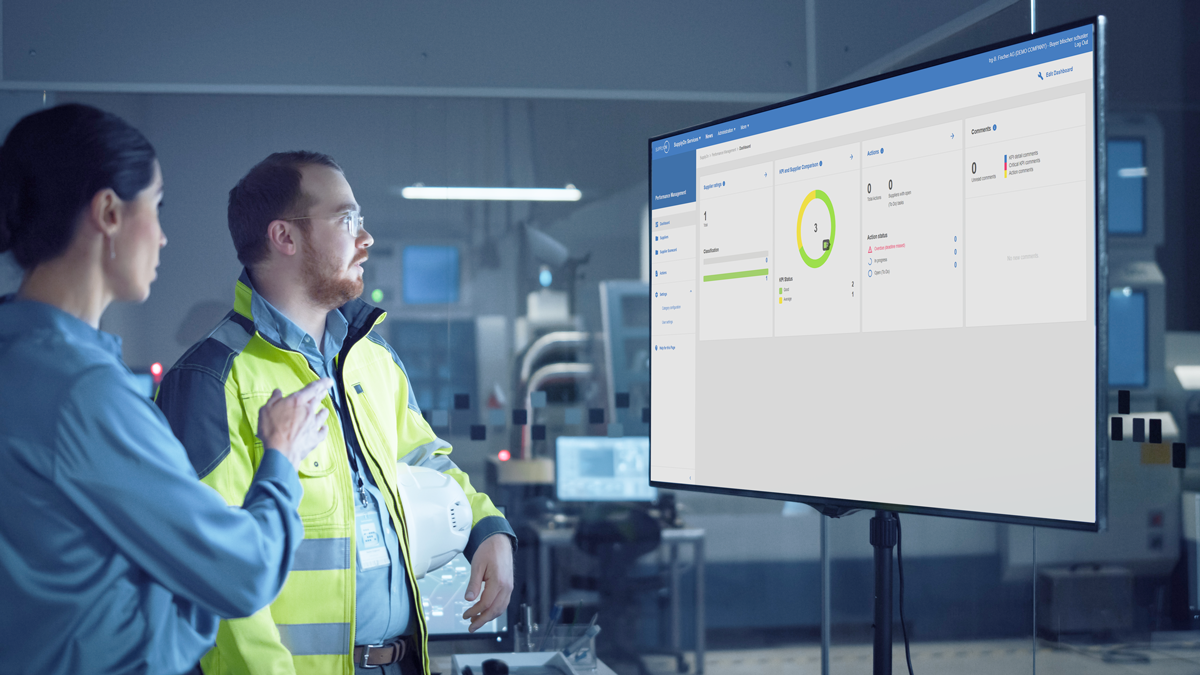
Two people in a modern industrial setting look at a large screen displaying data and charts, possibly discussing performance metrics or operational information.
Person pointing a pen at a computer monitor displaying a dashboard interface with charts, status indicators, and data tables in an office or industrial setting.

Analyze operational performance and investigate deviations

Complement formal supplier evaluations with operational KPIs. Monitor historical development and move from high-level results to detailed performance context such as plant, location, or part.

Performance data from existing customer systems can be used without replacing established measurement and calculation processes.

Business impact
  • Identify critical operational performance earlier
  • Understand where deviations occur
  • Move from high-level supplier assessments to the operational evidence needed for further analysis

Shared transparency and action management in KPI context

Give suppliers direct access to the performance information published to them, including historical results, detailed KPI information, and applicable performance context.

Where applicable, performance transparency can be extended with comments and structured improvement actions.

Business impact
  • Create a shared reference for supplier performance discussions
  • Reduce ambiguity around evaluation results
  • Provide a stronger factual basis for supplier-development activities

A person with curly hair and glasses works at a desk, looking at a computer monitor displaying a dashboard with graphs and charts in an office setting.

Turn supplier performance into measurable operational improvement

The value of supplier performance management comes from earlier issue detection, reduced manual effort, improved supplier alignment, and structured action tracking directly within KPI context.

Earlier detection of performance issues

KPI trends, thresholds, and drill-downs reveal deterioration before it impacts operations

Reduced effort in supplier performance reviews

Automated KPI updates, standardized scorecards, and alerts minimize manual preparation

Stronger supplier alignment through transparency

Shared KPI logic and visibility reduce disputes and improve collaboration

More effective corrective action tracking

Actions are managed directly in KPI context with clear ownership and follow-up

Less static reporting. More performance transparency. Faster improvement where it matters most.

Frequently asked questions

Questions about SupplyOn Performance Management

SupplyOn Performance Management provides a structured environment for monitoring, analyzing, and sharing supplier performance. It brings together formal supplier evaluations, often managed through supplier scorecards, with the operational performance information needed to understand performance in greater detail. Buyers can move from an overall supplier result to relevant KPIs and business context, while suppliers gain access to the performance information published to them.

Yes. Performance data and externally calculated results can be provided from existing customer systems. This allows organizations to retain established measurement and calculation processes while using SupplyOn as a structured environment for publishing, monitoring, analyzing, and sharing supplier performance.

Where available, selected data and KPIs from other SupplyOn services can also complement customer-provided performance information.

Yes. Customers can configure and independently modify supplier evaluations according to their own performance framework. Evaluation structures can include overall scores, performance categories, detailed KPIs, weighting logic, targets, thresholds, and traffic-light ranges.

Evaluations can also complement measured KPIs with qualitative assessments where required.

Yes. Supplier scorecards and comparative views allow teams to compare suppliers across categories and KPIs. Historical performance and trends help identify strong and weak performance and determine which suppliers or performance areas require closer attention.

Users can move from overall and category scores to detailed KPI information and historical performance. Where the relevant data is available, KPI values can be analyzed by dimensions such as plant, location, part, commodity, or division.

This helps users move beyond identifying that performance requires attention and understand where a deviation occurs.

Operational performance can include measures such as PPM, OTIF, average response times, or other KPIs provided through the relevant performance data.

These KPIs complement the consolidated supplier evaluation with the operational detail needed to understand performance developments.

Suppliers can directly access the performance information published to them, including evaluation results, operational KPIs, historical development, and relevant detailed information.

This gives buyers and suppliers a shared reference for performance discussions instead of relying only on separately distributed reports or spreadsheets.

SupplyOn Performance Management helps teams identify which performance areas require attention and provides the KPI history and business context needed for focused follow-up with suppliers.

Where collaboration capabilities are enabled, performance transparency can also be extended with comments and structured improvement actions.

When using SupplyOn Sourcing, buyers can consult supplier performance alongside sourcing information. This allows supplier performance to be considered together with sourcing information when making award decisions.

Supplier Performance Management

Make supplier performance easier to understand and act on

Bring supplier evaluation, operational performance, and shared transparency into one structured environment while continuing to use established performance data and calculation processes.

Identify what requires attention, understand where issues originate, and create a consistent basis for supplier discussions and improvement.